
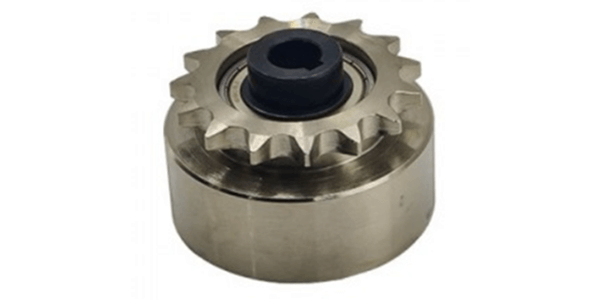
The principle of magnetic dampers is that the resistance generated by magnetic fields slows down the movement of objects. This reduces mechanical vibration and consumes kinetic energy
Composition: It usually consists of a moving object and a system that creates resistance through a magnetic field. When the object moves in the magnetic field, the permanent magnet system will produce a magnetic field that impedes the movement of the object, thus slowing down the speed of the object.
Application: multi-roll equipment
、
Permanent magnet damper is a new type of magnetic drive mechanism which appeared abroad in recent ten years. It uses the principle of magnetism to connect the main and passive magnetic pairs without contact through the magnetic force to transmit the torque. The damping torque can be adjusted from zero to the maximum by adjusting the air gap between the magnetic pairs. When the air gap distance is locked, the damping torque during operation can remain constant for a long time, and will not change with the relative speed changes of the main and passive pairs.
Advantage
The permanent magnet damper is composed of two half pairs, the structure is simple, and the operation process is connected by magnetic force, and the two have no direct contact friction. The gap adjustment (that is, the torque adjustment) is convenient, the installation size is small, the service life is long, and the fault is free.
It is widely used in institutions that need to provide a stable transmission moment, damping moment or tension, such as wire and cable, optical fiber and cable, film, textile, weaving and other machinery. In the cable, optical cable machinery, can be used as bundling machine, stranding machine, coating machine, paper charter, winding machine, wire drawing machine, winding machine, fiber coating machine, fiber optic cable yarn bandaging machine and other mechanical take-up and payoff, take-up and take-up tensioner used. Due to its constant torque characteristics, the tensioning torque can be unchanged in various occasions such as high speed, low speed, full plate and shallow plate. If the damper is coaxial with the caliper wheel, the wire and belt are drawn out through the caliper guide wheel, and the tension (F) of the wire and belt can be unchanged when the online speed changes.
It has incomparable advantages over the traditional methods of tensioning with rubber belts in the industry, or blocking wire trays with silk brushes to provide line and tension. Compared with the mechanism that controls the tension with a motor, it has the same tension quality, and its structure is much simpler. The adjustment is more convenient, the price is lower, and there is no fault, no maintenance. is no fault, no maintenance.
Use
(1) Any half of the magnetic pair of the damper is fixed, the other half is rotated with the coil axis, and the damper will apply a constant damping torque to the coil axis. If the half pair is mounted on the caliper guide wheel shaft, the line and belt are drawn out on the caliper guide wheel so that the line has a constant tension.
(2) Any half of the magnetic pair of the damper is fixed on the power shaft, and the other half pair is fixed on the passive shaft. When the power shaft is rotating, a constant torque is obtained on the passive shaft. When the gap of the magnetic pair of the damper is adjusted, the torque obtained on the passive shaft will not change due to the slip change caused by the load change.
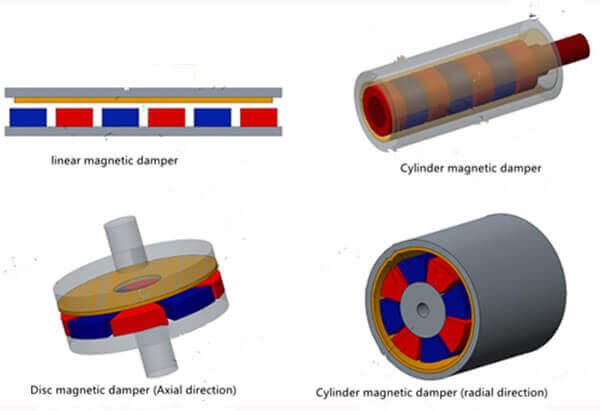
In the design and application of magnetic dampers, there are several key points that need special attention to ensure their performance and reliability. These considerations cover the design principles, material selection, manufacturing process, application environment and so on.
1. Design principle: magnetic field strength and distribution:
Ensure that the strength and distribution of the magnetic field is uniform to achieve a stable damping effect. The strength of the magnetic field needs to be precisely designed according to the application requirements, and too strong or too weak magnetic field can affect the performance.
Conductive material selection: Select suitable conductive materials (such as aluminum, copper, etc.) to ensure effective vortex generation. The conductivity and permeability of the material will directly affect the damping effect.
Damping adjustment: Design an adjustable magnetic field source (such as an electromagnet) or adjust the configuration of conductive materials to adjust the damping force according to actual needs.
Temperature management: The performance of the magnetic damper may be affected by temperature changes, and the influence of temperature on the magnetic field strength and the performance of conductive materials should be considered when designing, and effective temperature control measures should be taken.
1. Design principle: magnetic field strength and distribution:
Ensure that the strength and distribution of the magnetic field is uniform to achieve a stable damping effect. The strength of the magnetic field needs to be precisely designed according to the application requirements, and too strong or too weak magnetic field can affect the performance.
Conductive material selection: Select suitable conductive materials (such as aluminum, copper, etc.) to ensure effective vortex generation. The conductivity and permeability of the material will directly affect the damping effect.
Damping adjustment: Design an adjustable magnetic field source (such as an electromagnet) or adjust the configuration of conductive materials to adjust the damping force according to actual needs.
Temperature management: The performance of the magnetic damper may be affected by temperature changes, and the influence of temperature on the magnetic field strength and the performance of conductive materials should be considered when designing, and effective temperature control measures should be taken.
What we can do for you ? ----Support OEM /ODM /CUSTOMIZATION
Choosing the best environment for the use of magnetic dampers needs to consider the type of magnet and the specific conditions of the environment. Samarium cobalt magnets are suitable for high temperature and corrosive environments, while Ndfeb magnets are suitable for high magnetic strength applications. According to the environmental conditions, such as temperature, humidity, chemical corrosion, mechanical vibration and electromagnetic interference, select the appropriate magnet type and corresponding protective measures to ensure the performance and life of the magnetic damper.